Why Louisiana’s Swamp Tours Are More Than Just Sightseeing
A lot of people show up for a swamp tour with one goal in mind: see a gator, take a picture, tell friends back home they survived. That’s understandable. Alligators get all the publicity. They’re prehistoric, photogenic, and very good at holding still like they’re posing for postcards. But if spotting a gator was the whole story, swamp tours would last about five minutes and end in the parking lot.
Louisiana’s swamps are not theme parks. They’re living systems. Complex, messy, noisy, constantly changing systems that don’t care about camera angles or vacation schedules. A guided swamp tour exists to help people understand what they’re actually looking at, not just point at something with teeth and call it a day.
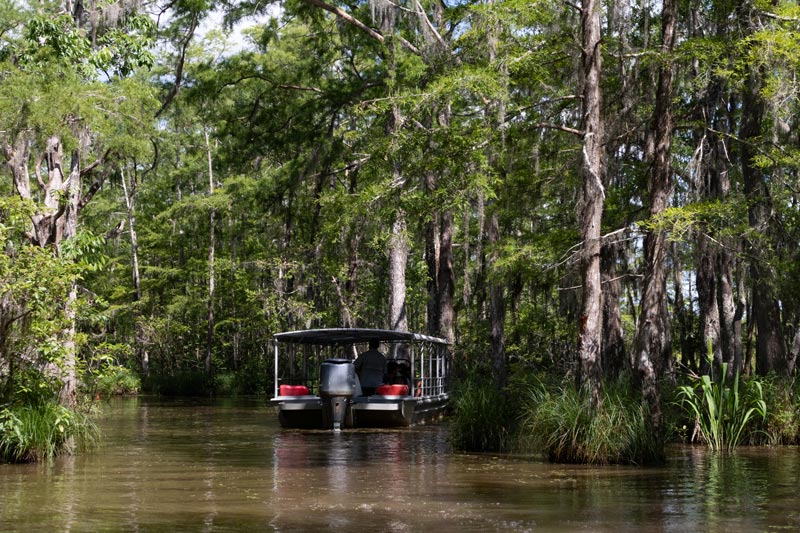
Wetlands are shaped by water first and everything else second. Water depth, flow, salinity, and seasonal changes determine what grows, what lives there, and how the system behaves. A guided tour explains why one area looks like a forest, another like open marsh, and another like something in between. Cypress trees, tupelo gums, floating vegetation, and grasses all tell a story about water conditions if someone knows how to read it.
Wildlife works the same way. Animals don’t just randomly appear for entertainment purposes. Alligators bask because temperature matters. Birds gather where food sources are reliable. Turtles pile onto logs because that’s how thermoregulation works. When guides explain behavior instead of just naming species, sightings start to make sense. The swamp stops feeling random and starts feeling organized in its own very swampy way.
Birds are usually the quiet stars of a tour. Herons, egrets, ibis, hawks, owls, and migratory species pass through wetlands for specific reasons tied to seasons and food availability. Guided tours explain how Louisiana’s wetlands function as rest stops along massive migration routes. That white bird standing motionless in the shallows isn’t bored. It’s working.
Plants don’t get enough credit, but they do most of the heavy lifting. Vegetation stabilizes soil, filters water, provides shelter, and supports the food web from the bottom up. Cypress knees confuse almost everyone at first, which makes them perfect teaching tools. Once people understand why they exist and what they indicate about water conditions, the swamp becomes less mysterious and more impressive.
Culture is woven into every part of the swamp. People didn’t settle around wetlands by accident. Indigenous communities, Cajuns, and later generations adapted their lives around fishing, trapping, boat travel, and seasonal cycles. Guided tours explain how the environment shaped livelihoods, language, and traditions. The swamp isn’t separate from culture. It created it.
Place names, accents, and customs make more sense once the environment is understood. French, Spanish, African, and Indigenous influences didn’t just collide randomly. They blended here because the landscape demanded adaptation and cooperation. Swamp tours provide that context in a way no sign or brochure ever could.
Environmental change becomes easier to understand when it’s visible. Coastal erosion, land loss, saltwater intrusion, and changing water patterns aren’t abstract ideas when they’re pointed out along a tour route. Seeing where land used to be or how vegetation has shifted turns environmental discussions into real conversations grounded in observation rather than headlines.
Guided tours also exist for practical reasons. Swamps are not casual walking environments. Water levels change. Wildlife behaves unpredictably. Navigation requires experience. Guided access allows people to explore safely without damaging sensitive areas or putting themselves in situations they didn’t plan for. Education and safety tend to work well together.
There’s also a long list of swamp myths that need regular correction. Swamps are not stagnant pools of danger waiting to swallow unsuspecting visitors. They’re dynamic systems full of movement, sound, and life. Guided tours replace exaggerated fear with understanding, which usually leads to respect instead of discomfort.
A good swamp tour feels less like sightseeing and more like a conversation with the landscape. Guides translate what’s happening in real time. Why the water looks that way. Why the animals behave that way. Why the plants grow where they do. Suddenly the swamp stops being a backdrop and starts being the main subject.
Yes, alligators still show up. They always will. But when visitors understand how gators fit into the ecosystem instead of treating them like mascots, the experience changes. The same goes for birds, trees, and even muddy water. Everything has a role.
The best tours leave people with more questions than they arrived with, and that’s a good thing. Curiosity means something clicked. It means the swamp became more than a photo opportunity.
Louisiana’s wetlands deserve more than a quick glance. Guided swamp tours slow things down just enough for understanding to catch up. They turn a boat ride into an informal classroom where ecology, history, and culture overlap naturally.
Seeing a gator is fun. Understanding why the swamp exists at all is better.